Firefly lost for 92 years rediscovered
Photuroluciola deplanata is a species of firefly approximately 15–20 mm long, a black elongate beetle with a rufous pronotum and tip of the abdomen. Fireflies, are famed as the group of insects who display bioluminescence, with mostly the juveniles and adult females emitting light from specialised light-producing photophore organs by a unique chemical reaction. In most species, adults use their bioluminescence to attract mates, although in some species, adult females mimic the light-shows of females of other firefly species to catch and eat the males as a source of defensive chemical compounds.
This species of firefly was first described from one male specimen collected near Antongil Bay area in northern Madagascar in 1931 and has not been seen since. The voucher specimen (called ‘holotype’) of the species is deposited at the Museum national d’Histoire naturelle in Paris.
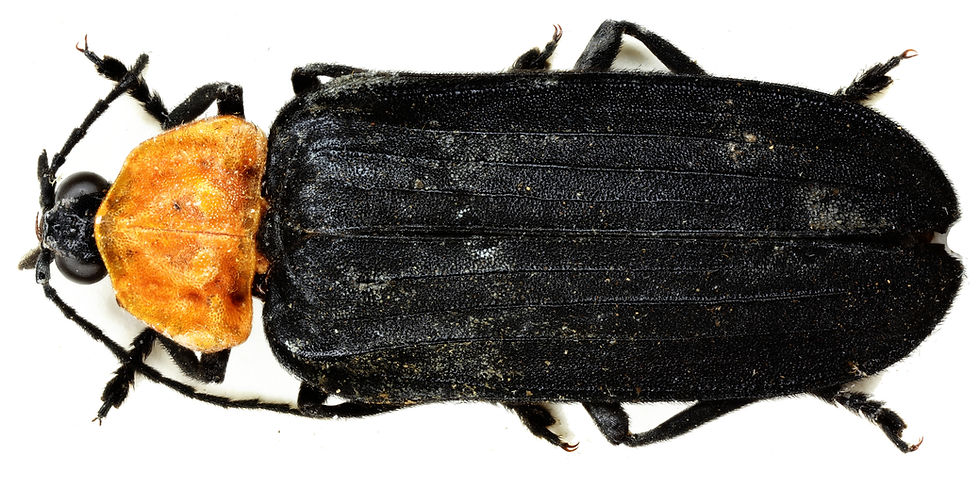
In September 2023, the multi-institutional expedition to Madagascar funded by the RIDGES Foundation and Re:wild was searching for lost species of animals in the Makira Forest Natural Park north of the Antongil Bay. On the very last day of the expedition, a night camp was set on a Antainambalana riverside, already outside the Makira Forest, and a last survey
of insects was performed by Dr Dmitry Telnov and Merlijn Jocque of the BMNH and BINCO.
Two years after the expedition, Michael Geiser, a known specialist on glowworms and related beetle groups from the Natural History Museum London, UK, confirmed the presence of a male specimen of Photuroluciola deplanata in the material from the Antainambalana camp.
This is only the second known specimens of this species, rediscovered after nearly a century of being lost to science. The specimen was attracted to a light trap during the survey. The circumstances (remoteness of the area, lack of proper entomological survey in the area and peculiarities of the insect population ecology (e.g., short life cycles) suggest that there is a viable population of the glowworm present in northern Madagascar. The female of Photuroluciola deplanata remains unknown to science.
We are thankful to our collaborative partners: Re:wild, American Bird Conservancy, BMNH, the Peregrine Fund, WCS, BINCO, the Universite d'Antananarivo and the Malagasy Ministry of Environment and Sustainable Development for their support of this expedition.


Comments